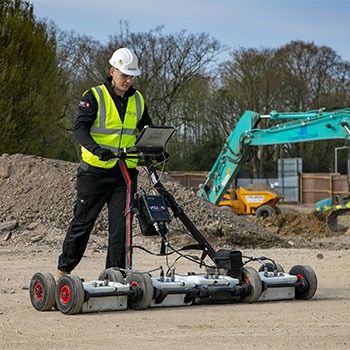
Underground Utility Detection and Mapping

Vision Survey are able to carry out a comprehensive 3D survey of your site using the latest technological methods of Ground Radar and Electromagnetic Detection and provide you with a comprehensive digital representation of all the underground utilities in your site. The survey will provide the following information:


  • Utility Location

  • Utility Type

  • Utility Size

  • Utility Depth

  • Utility Configuration
Utility Detection & Mapping

The Technology

Our survey techniques and methods are Electromagnetic Detection (RD8000), Ground Penetrating Radar (GPR), manhole inspection and recording, site investigation and the use of record drawings. These methods allow us to detect the full range of utilities, e.g. electric, telecom, gas, CATV, and cast iron pipes.

Radar

Electromagnetic techniques are unable to detect non-metallic buried services including plastic water pipes, gas and clay drainage pipes. In order to overcome this potentially hazardous situation, Vision Survey use Ground Penetration Radar (GPR). The technology has been developed over the past thirty years for shallow, high resolution investigations of subterranean features. 3D images of the surveyed area can be provided with accurate depth estimates for the located features. It uses the principle of the scattering of electromagnetic waves to locate buried objects. The reflected waves are then received by an antenna that is part of the unit. An LCD monitor is then used to easily determine target locations on site. Image data can be saved from screen and converted to JPEG format.

Electromagnetic Detection

This technique works on the basis that a current flowing along the conductor creates a magnetic field. When a receiver is swept across the field it will detect the signal. In principle the centre line of the buried service is where the response from the field is shown at its maximum strength on the receiver. This technique makes use of both active and passive radiated energy to detect buried services. An active signal is one that has been artificially generated by the transmitter by either direct connection or induction. A passive signal relates to the naturally transmitted signal on a buried conductor. This technique is used in conjunction with a 'flexitrace' or sonde to accurately trace service routes.


The Benefits

Contact Vision Survey

Vision Survey Clients